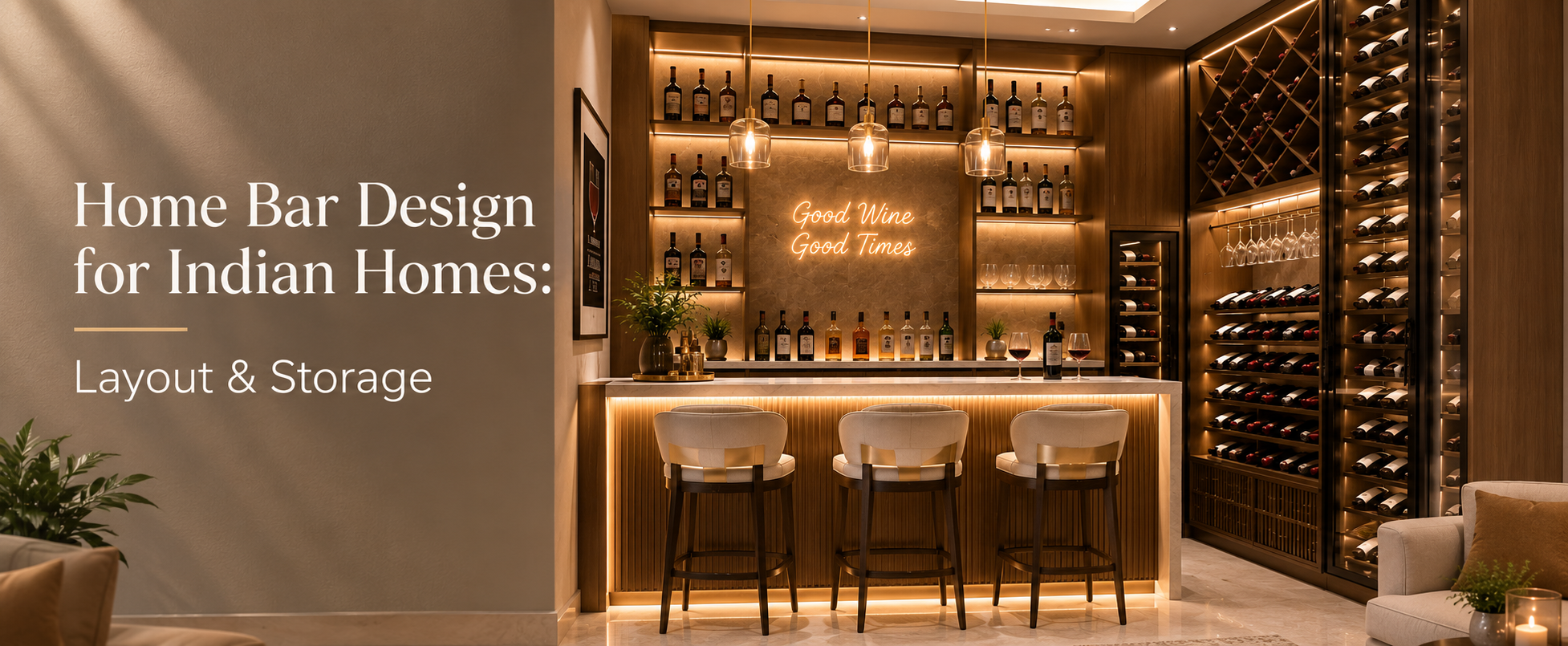
Home Bar Design for Indian Homes: Layout, Storage, Lighting & Materials
A wet bar with a polished quartz counter and brass hardware adds immediate value to an Indian apartment—provided the plumbing works. 63% of homeowners prioritize a dedicated entertaining zone over a traditional dining extension, according to a 2024 Houzz survey. To get this right, your home bar design must nail four things: layout, storage, lighting, and materials. Whether you want a moody corner or a full wet bar, Studio Deco Arte builds spaces that actually work for entertaining.
How to design a bar for home that balances aesthetics and function?
A functional home bar starts with an honest assessment of your floor plan. You need at least 36 inches of clearance in front of the counter to mix drinks without bumping elbows. Choose a built-in cabinet if you entertain weekly; pick a mobile cart if you rarely host. Scale dictates the layout.
Assessing your available floor space and traffic flow
The layout must respect traffic flow. If your living room acts as a corridor to the balcony, do not put a stationary bar counter in that path. A single-wall dry bar works well in compact urban apartments. For larger bungalows, an L-shape or U-shape bar creates a distinct destination zone.
When mapping out the layout, consider how guests move. You want them to gather without blocking the main walkway.
Choosing between built-in cabinetry and mobile bar carts
Built-in cabinetry integrates flawlessly with your existing living spaces. It offers deep storage for spirits and dedicated racks for stemware. A mobile bar cart, on the other hand, offers flexibility. You can wheel it onto the balcony for a sunset drink and tuck it away later.
The choice comes down to how often you entertain. If you host large Diwali parties or frequent weekend dinners, built-in cabinetry is worth the investment. For occasional use, a well-styled cart performs just as well.
What are the best contemporary home bar design ideas for 2026?
The biggest shift in 2026 is the move away from flashy, mirrored displays toward moody, enclosed nooks. Contemporary home bar design ideas now favor deep, saturated colors and statement backsplashes over generic wood paneling. According to Houzz, homeowners increasingly prefer bars that feel like distinct destinations rather than extensions of the kitchen.
Integrating moody nooks and dedicated entertaining zones
We are seeing a massive shift toward moody nooks. Homeowners are carving out small, dedicated entertaining zones in unused corners. By painting the walls a deep forest green or navy and adding a single pendant light, you instantly create a speakeasy vibe.
A recent Homeworthy tour highlighted a foyer bar featuring leather upholstery and antique mirrored backs. This proves you do not need a massive footprint. A tiny nook can feel incredibly luxurious if the lighting and materials are right. You can see how we've approached similar moody, layered spaces in our portfolio.
Using bold colors and statement backsplashes
A statement backsplash anchors the entire space. Backsplash.com recently showcased a white beige marble mosaic backsplash paired with fluted wood cabinetry. The marble reflects the integrated light, making the space feel warm and polished.
For contemporary home bar design ideas, try a full-height backsplash that runs from the counter to the ceiling. This draws the eye upward and makes the area feel larger than it is.
How do you optimize storage and lighting for a home bar design?
Proper storage keeps glassware dust-free; layered lighting sets the mood. A good home bar design incorporates specialized wine racks and stemware holders alongside ambient, task, and accent lighting. You need the right bottles lit correctly.
Layering task, ambient, and accent lighting
Never rely on a single overhead light for a bar. A striking space requires three layers. Task lighting under the upper cabinets illuminates the workspace for slicing garnishes. Accent lighting inside glass-front cabinets highlights your best crystal. Ambient lighting—a glowing pendant or a wall sconce—warms the room.
As Customized Designs points out, a serious bottle collection deserves a serious display. They use low-profile LED liquor shelving to highlight the labels. Integrated bar lighting is the difference between a bar that looks like a pantry and one that looks like a lounge.
Incorporating specialized wine racks and stemware holders
Storage needs to be specific to what you drink. Storing wine horizontally keeps the cork moist. Specialized wine racks built into the lower cabinetry achieve this.
For stemware, hanging racks free up shelf space. They also keep the glasses accessible. If your home bar design features a dry bar, you can use etched glass fronted cabinets to protect the interiors from dust.
Which materials are most durable for luxury home bar design for modern homes?
Quartz and marble are the top choices for luxury home bar design for modern homes. Quartz handles spills without etching, while marble offers unmatched visual luxury. Treated wood adds warmth but requires sealing to prevent wine stains.
Selecting quartz, marble, and treated wood countertops
Marble looks stunning but requires maintenance. It will etch if lemon juice or wine sits on it. Quartz, on the other hand, is non-porous. It survives spilled negronis and lime wedges without a single stain.
We typically recommend a dark quartz or treated wood for a heavily used bar. The deep green marble countertop featured in a Backsplash.com design idea is stunning, but you must wipe spills immediately.
Balancing high-end aesthetics with easy maintenance
Balance is key. You want the aesthetic of luxury with the ease of a commercial space. Use stainless steel or brass for the sink fixtures—these materials resist corrosion from citrus and alcohol.
A sealed marble backsplash is fine for a dry bar. For a wet bar where mixing happens daily, engineered stone is the smarter move. You get the look of natural stone without the stress.
How much does a home bar design cost in India?
A basic dry bar starts at ₹25,000, while a custom luxury wet bar easily exceeds ₹2,50,000. The final cost depends on your choice between modular and custom construction, the finish level, and the appliance integration. Plumbing dictates the wet bar premium.
Breaking down modular versus custom pricing
Modular bars offer a fixed price tag. You choose a unit, it arrives, and the installer sets it up in a day. Custom carpentry costs more because it involves specialized labor. A luxury home bar interior designer in Delhi will charge a premium for bespoke millwork that fits perfectly into odd architectural corners.
Custom work ensures your home bar design integrates perfectly with Indian home aesthetics, utilizing local wood and stone.
Factoring in luxury finishes and specialized appliances
Luxury finishes drive the price up fast. A built-in wine cooler costs more than a mini-fridge. A statement backsplash using imported artisan mosaic tile adds significant material cost.
If you want a beer tap or a built-in ice maker, factor in the plumbing costs. Country Creek Builders notes that wet bars require specialized plumbing, which adds to the budget.
Why hire a luxury home bar interior designer in Delhi for your project?
A specialized designer manages bespoke carpentry and sources local materials that fit Indian climates. They ensure your bar blends with your living room rather than looking like an afterthought. Studio Deco Arte handles this integration flawlessly.
Navigating bespoke carpentry and local material sourcing
Sourcing materials locally in Delhi saves time and money. A local designer knows which quarries carry the best quartz and which carpenters execute fluted wood details flawlessly.
Bespoke carpentry requires precise measurements. A luxury home bar interior designer in Delhi coordinates the contractors, ensuring the plumbing, electrical, and carpentry align perfectly.
Ensuring cohesive integration with your existing living spaces
Your bar must match the rest of your home. If your living room features Italian marble floors, the bar should complement that. A good designer selects a coordinating palette.
They ensure the home bar design does not clash with your dining area. They focus on flow, ensuring the space feels like a natural extension of your home.
What are the top home bar design for entertainment spaces?
The best home bar design for entertainment spaces bridges indoor and outdoor areas. For large gatherings, an open layout with a peninsula counter works best. For intimate nights, a dedicated alcove with bar stools creates a cozy, private feel.
Creating seamless indoor and outdoor transition bars
Homes with balconies or terraces benefit from a transition bar. A movable partition or a folding window connects the indoor living space to the outdoor balcony bar.
This layout is perfect for entertaining. Guests can flow freely between the air-conditioned interior and the open-air balcony.
Designing for large gatherings and intimate nights in
For large gatherings, you need a wide counter. A peninsula bar allows multiple people to stand around it. Include a wine fridge and plenty of ice storage.
For intimate nights, skip the heavy seating. Two plush bar stools and a dimmer switch transform the space into a quiet retreat.
Conclusion: Elevating your home bar design experience
A great home bar design combines practical layout, smart storage, layered lighting, and durable materials. Whether you want a moody nook or a fully equipped wet bar, the details make the difference. Trust Studio Deco Arte to bring your vision to life. Reach out to our team today to start crafting a space that keeps the conversation flowing and the drinks perfectly chilled — browse our recent work on Instagram, follow us on Facebook, or connect with us on LinkedIn.
Key Takeaways
- Ensure at least 36 inches of clearance in front of the counter for functional movement.
- Layer task, ambient, and accent lighting to create a lounge-like speakeasy atmosphere.
- Choose quartz for daily wear or marble for visual luxury, depending on your maintenance capacity.
- Expect basic dry bars to start at 25,000 rupees, while custom wet bars easily exceed 250,000 rupees.
- Opt for moody colors and full-height backsplashes to align with 2026 contemporary design trends.
Comparison
| Feature | Built-in Cabinetry Bar | Mobile Bar Cart |
|---|---|---|
| Space Requirement | Needs dedicated floor space | Fits in compact corners |
| Storage Capacity | Deep storage for spirits | Limited surface area |
| Flexibility | Fixed location | Highly movable |
| Cost Estimate | Higher investment | Budget-friendly |
| Best For | Frequent hosts | Occasional use |
Frequently Asked Questions
How to design a bar for home?
A functional home bar design starts with assessing your floor plan and ensuring at least 36 inches of clearance. Choose built-in cabinetry for frequent hosting, or pick a mobile cart for occasional use. Incorporate layered lighting, specialized wine racks, and durable countertops to balance aesthetics and daily function.
How much does a home bar design cost?
A basic dry home bar design starts at around 25,000 rupees, while a custom luxury wet bar can exceed 250,000 rupees. Modular units offer fixed pricing, whereas custom carpentry involves specialized labor. Your final cost depends on premium finishes, bespoke millwork, and integrated appliances like wine coolers.
What are the trends for home bars in 2026?
Contemporary home bar design ideas for 2026 favor moody, enclosed nooks over flashy mirrored displays. Deep saturated colors like forest green and navy are popular. Full-height statement backsplashes, fluted wood cabinetry, and dedicated entertaining zones that feel like distinct destinations are highly preferred.
Which materials are best for a home bar countertop?
Quartz and marble are top choices for a luxury home bar design. Quartz is non-porous and easily handles spills without etching, making it ideal for daily mixing. Marble offers unmatched visual luxury but requires immediate wiping. Treated wood adds warmth but needs sealing to prevent wine stains.